Some time ago, I ‘discovered’ the NP-Fxxx battery series, which was originally a professional series from Sony, but has become a de facto standard for all photographic accessories and is therefore frequently replicated and offered by third-party suppliers. There are also matching ‘battery plates’ – battery adapters that adapt the connection of an NP-F battery to any format.
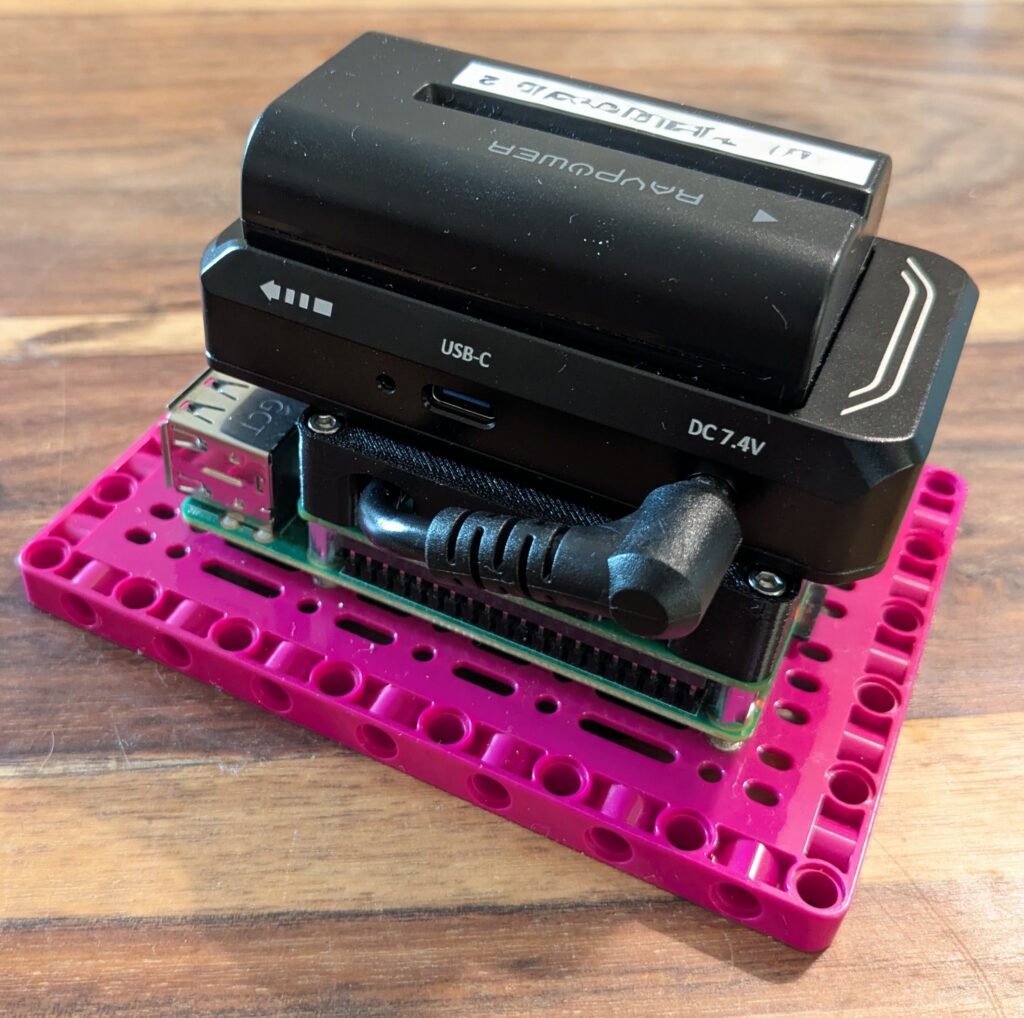
Here is an example of how I power a Raspberry Pi including a ‘Pi Build Hat’ (= an adapter board for connecting LEGO LPF2 components) from an NP-F battery (I used AI to remove the sticker with my contact details, which is why it looks strange):
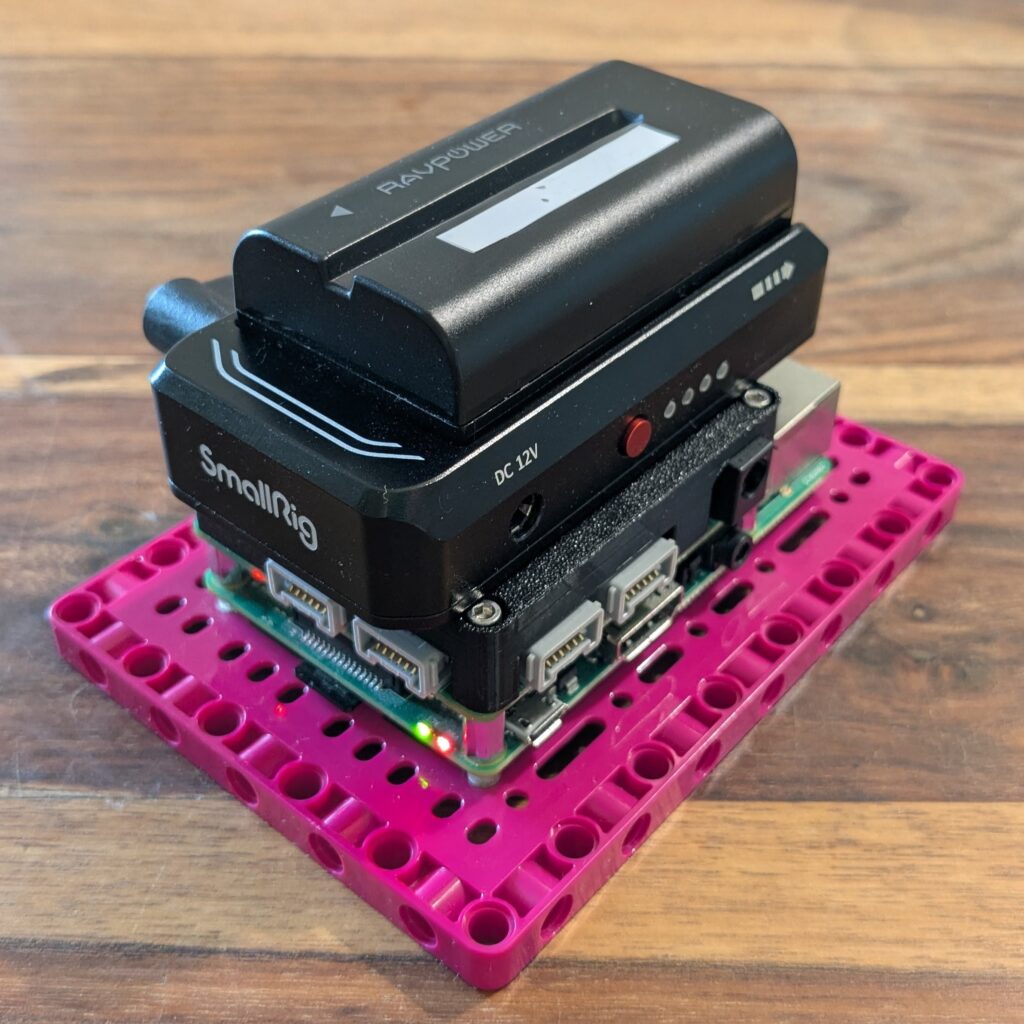
The adapter plate I use also serves as a charger and is one of the more sophisticated ones: https://www.smallrig.com/de/SmallRig-NP-F-Battery-Adapter-Mount-Plate-Advanced-Edition-3168B.html – It can also charge the battery and serve as a power bank (USB-C) if necessary. It normally costs around £60, but I got it cheaper on Black Friday.
However, there are also cheaper versions, such as this one: https://www.smallrig.com/de/smallrig-np-f-battery-adapter-plate-lite-3018.html (also from SmallRig, approx. £33) or this one: https://www.amazon.de/NP-F-Netzadapter-Schnellladefunktion-Typ-C-Eingang-Stromversorgung/dp/B0CWR3VFNV/ (€35, also has a USB output as a power bank and can also charge the battery).
The various adapter plates all have what is most important for us: a 7.4V DC5521 connection, i.e. a barrel connector with an outer diameter of 5.5mm and an inner diameter of 2.1mm, where the battery voltage is more or less looped through directly (SmallRig also has a deep discharge protection switch in series to protect the battery).
Most adapter plates also have a second barrel connector where the battery voltage is internally boosted to 12V, but this has the DC5525 format, meaning the inner pin is 2.5mm thick – to prevent mistakes: while you can insert a 5525 plug into the 5521 socket, most 12V devices won’t be damaged if they are supplied with only 7.4-8.4V (at most, they will not switch on). However, a 5521 plug cannot be inserted into a 5525 socket, so 7.4V devices will not accidentally be supplied with 12V.
The Raspberry Pi Build Hat is designed for direct power supply from 2 lithium cells, i.e. 6.0-8.4V, and has a DC5521 socket as its input. Therefore, if you get an NP-F adapter plate, a DC5521 to DC5521 cable and an NP-F battery, you can plug it all together quite easily and the Raspberry Pi Build Hat will be happy with it (the Build Hat has its own power converter to provide 5VDC to the Raspberry Pi SBC underneath). Since the batteries are protected against deep discharge and the adapter plates (at least the good ones from SmallRig) also have built-in safety mechanisms, the whole thing is reasonably foolproof.
The NP-F batteries are available in three basic ‘flavours’:
- NP-F5xx (e.g. NP-F550, 2×18650 cells)
- NP-F7xx (e.g. NP-F750 4× 18650 cells, 2 in parallel each) and
- NP-F9xx (e.g. NP-F970 6× 18650 cells, 3 in parallel each).
With original Sony batteries, the last two digits of the type designation encode the battery capacity (e.g. NP-F530 was a 1350mAh battery, while an NP-F570 had 2200mAh). The replicas usually have a capacity that does not match the type designation, so only the first digit after NP-F is relevant, from which the size (number of cells) can be inferred.
Furthermore, there are increasingly more NP-F batteries that have a built-in power bank or charging function, which are often larger than the SONY originals, so you have to see for yourself what makes sense and what doesn’t. The capacity specifications are also often rather optimistic (I own two NP-F550 batteries with a printed capacity of 2900mAh, which in reality have 2300-2400mAh).